 blog
Best Senior Portrait Wall Art for Your Home
Last Updated: October 23, 2026
Quick Summary
Senior portrait wall art transforms a graduation milestone into a lasting family heirloom by displaying your child's authentic image as a centerpiece of your home. The best choice depends on your space and style: canvas prints bring contemporary gallery quality, framed prints offer timeless versatility, and metal prints suit modern interiors.
- Canvas prints work best in bright rooms with windows because their matte surface eliminates glare
- A gallery wall anchor image should print at 16 by 20 inches or larger, with supporting prints at 11 by 14 inches and 8 by 10 inches
- Hang portraits with their center at 57 to 60 inches from the floor for eye-level viewing
- UV-protective glass or acrylic prevents fading over decades when portraits hang in sunny rooms
- Consistent 2 to 3 inch spacing between frames in a gallery wall reads as intentional design
Table of Contents
- What Makes Senior Portrait Wall Art Worth the Investment
- Senior Portrait Wall Art Ideas That Suit Your Home
- How to Choose Senior Portrait Wall Art for Your Space
- Creating a Senior Portrait Gallery Wall
- Senior Portrait Framed Prints: Materials and Finishes
- Sizing and Placement for Maximum Impact
- Caring for Your Senior Portrait Heirlooms
- Frequently Asked Questions
What Makes Senior Portrait Wall Art Worth the Investment
The best senior portrait wall art transforms a milestone moment into a lasting family heirloom. Unlike mass-produced prints or digital files that fade into phone storage, thoughtfully displayed senior portraits become the centerpiece of your home, a daily reminder of who your child was at this pivotal moment.
When you invest in senior portrait wall art, you're not just buying a picture. You're creating something that will be passed down, framed in memory, and valued for generations. At Swartz Portraits, we understand that the right wall display elevates the entire experience. The session itself captures authenticity and personality. The print you choose to display tells the story of that session to everyone who sees it.
Senior portrait wall art serves a specific purpose: it honors the achievement of graduation while celebrating the individual your child has become. Choose how your senior's portraits come home to see the heirloom collections and wall art options available. This is why the choice of format, frame, and placement matters so deeply. A canvas print in a contemporary living room feels entirely different from a classic framed portrait in a hallway. Both are beautiful. Both tell a story. The story changes depending on how you display it.
Senior Portrait Wall Art Ideas That Suit Your Home
Your home has its own aesthetic. Your senior portrait wall art should reflect that, not fight against it. The right choice depends on your space, your style, and what you want the portrait to communicate.
Canvas Prints for Contemporary Spaces
Canvas prints bring a modern, gallery-quality feel to any room. They work especially well in homes with clean lines, neutral palettes, or minimalist design. A canvas portrait hung without a frame creates an artistic, unfussy appearance that reads as intentional and sophisticated.
Canvas prints also offer flexibility in size. A large canvas print can serve as a statement piece on a feature wall. Smaller canvas prints cluster well in gallery arrangements. The texture of canvas adds depth that flat prints cannot match. Light hits canvas differently than glass, creating subtle shadows that make the image feel more dimensional.
Canvas is particularly effective when the senior portrait has strong natural lighting or outdoor elements. Photographs taken at Lake Conroe or The Woodlands Waterway translate beautifully to canvas. The organic quality of the scene is enhanced by the organic texture of the material.
Classic Framed Prints for Timeless Appeal
A framed print never goes out of style. This is the format families choose when they want something that will look equally beautiful in 10 years, 25 years, and beyond. Classic framing works in any home design, traditional, contemporary, eclectic, or transitional.
The frame itself becomes part of the composition. A simple black frame creates a modern look. Natural wood frames feel warm and approachable. White frames offer clean elegance. The mat color and width influence how the portrait is perceived. A wide mat draws attention to the image. A narrow mat or no mat at all feels more editorial.
Framed prints are the most versatile choice for senior portrait wall art. They work in entryways, living rooms, bedrooms, and hallways. They can be hung alone or grouped with other images. They integrate seamlessly into existing décor.
Large Single Portraits as Statement Pieces
A large single portrait commands attention. It becomes the focal point of the room. This approach works when you have one image that truly captures your child, an expression, a moment, a feeling that you want to live with every day.
A statement piece portrait should be printed large enough to have impact. Smaller prints feel tentative. Larger prints feel confident and intentional. The size communicates that this moment matters. This person matters. This achievement deserves to be seen.
How to Choose Senior Portrait Wall Art for Your Space
Choosing the right senior portrait wall art requires thinking about three things: the image itself, the format, and where it will live in your home.
Start with the image. Which portrait best captures who your child is right now. Not who they were as a child. Not who you hope they'll become. Who are they at graduation. The image should feel authentic. It should look like them. When you see it on the wall, it should make you smile because it's so perfectly them.
Next, consider the format. An investment in fine art, not a transaction explains what heirloom collections include and how the investment structure works. Canvas prints feel contemporary and artistic. Framed prints feel timeless and intentional. Both are museum-quality when produced with care. The format should complement your home's existing aesthetic. If your home is modern, canvas may feel more natural. If your home is traditional or eclectic, a frame may integrate more seamlessly.
Finally, think about placement. Where will the portrait live. A large statement piece works best as a focal point, above a sofa, on a feature wall, or in an entryway. Smaller framed prints work well in clusters or in secondary spaces like bedrooms or hallways.
Creating a Senior Portrait Gallery Wall
A gallery wall is the most flexible way to display multiple high school senior portraits from one session. It lets you show range: a close headshot, a full-length image from Lake Conroe, a quiet moment at Mercer Botanic Gardens. The arrangement itself becomes part of the story.
The gap most guides leave is the practical part. How many frames. What sizes. Where the nails go. Here is a working method you can take to the wall.
Choose the Anchor Image First
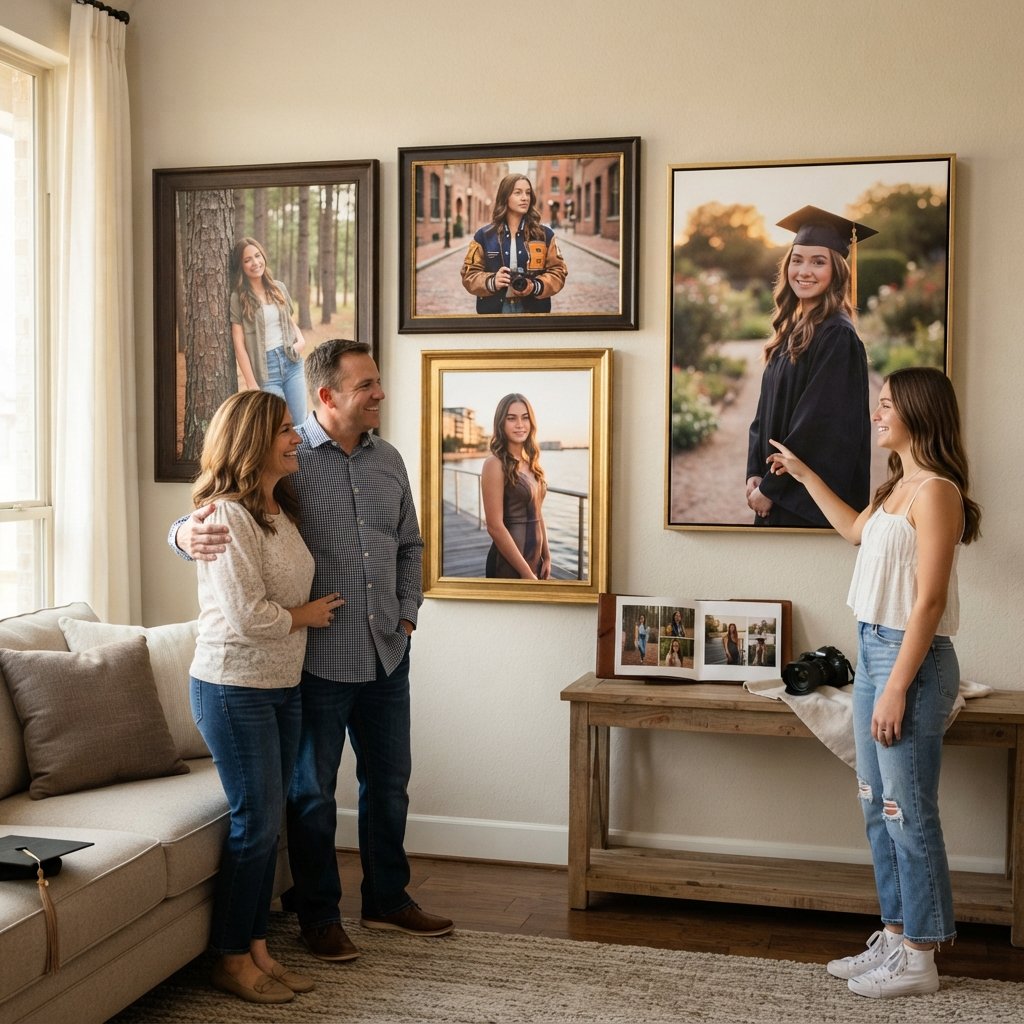
Every strong gallery wall has one anchor portrait. This is the image that best captures your senior right now, the expression you want to see every day. Print the anchor larger than the rest, typically 16 by 20 inches or 20 by 24 inches. Every other frame supports it. Balancing this centerpiece against smaller surrounding pieces requires a thoughtful approach to choosing large wall art that complements the scale of your living space.
A common pattern is one anchor, two medium prints at 11 by 14 inches, and three to five small prints at 8 by 10 inches. That gives you six to eight pieces, enough to feel like a collection without crowding the wall.
Map the Wall Before You Buy Frames
Measure the wall width and height. A gallery wall should occupy roughly 60 to 75 percent of the available width above a piece of furniture. Above a sofa, keep the bottom row 8 to 10 inches above the sofa back so the arrangement reads as connected to the furniture, not floating.
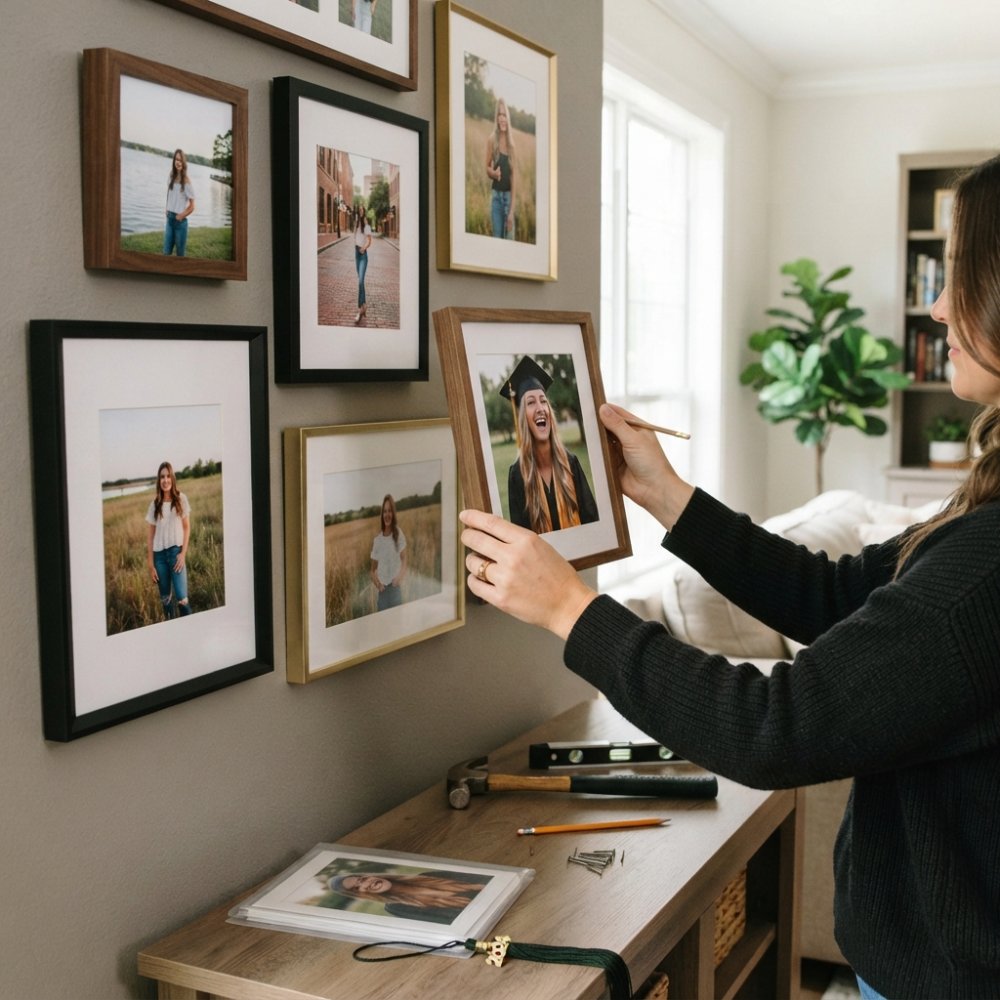
Lay the frames on the floor in the exact arrangement you plan to hang. Or cut paper templates to size and tape them to the wall. Live with the templates for a day. Adjust before you commit to nails.
Three Arrangements That Work
The grid. Same-size frames in even rows and columns. Formal, calm, and easy to hang. Best for a hallway or a bedroom where you want order.
The salon. Mixed sizes with the anchor centered and smaller frames radiating outward. Spacing stays consistent at 2 to 3 inches between frames. This is the most personal arrangement and the one most families choose for a living room.
The shelf ledge. A single picture ledge holds overlapping frames at different heights. No nails beyond the ledge itself. This works well in a rental or when you expect to add frames over time.
Keep Spacing and Alignment Consistent
Pick one gap, usually 2 to 3 inches, and use it everywhere. Inconsistent gaps read as accidental. Consistent gaps read as designed.
Align the center of the arrangement at 57 to 60 inches from the floor. That is eye level for most adults and keeps the anchor image in the natural sightline.
Mix Frames With a Rule
Choose two or three frame finishes and repeat them. A common combination is a black frame for the anchor, natural wood for the medium prints, and thin white frames for the small pieces. Repeat each finish at least twice so the wall feels unified.
Keep mat widths consistent across the wall. A 2 inch white mat on every frame ties mixed finishes together. Colored mats can echo a color from the senior's outfit, but limit yourself to one accent color.
Plan for Growth
A gallery wall can grow. Leave one open slot in the arrangement for a future portrait, perhaps a sibling's session or a second image from the same senior year. A wall that has room to expand stays current longer than one that is filled edge to edge on day one.
Senior Portrait Framed Prints: Materials and Finishes
The material you choose determines how a high school senior portrait looks on the wall and how it holds up over decades. Framed prints, canvas, and metal each behave differently under light, humidity, and time. Here is how they compare.
Framed Prints
A framed print is paper under glass or acrylic, held in a frame with a mat. It offers the widest control over presentation: frame finish, mat width, mat color, and glass type.
Durability. With UV-protective glass or acrylic, a framed fine art print resists fading for decades. The frame protects the edges. The mat keeps the print off the glass, which prevents sticking in humid rooms.
Glare. Standard glass reflects light. Museum glass and anti-reflective acrylic reduce glare substantially, which matters in a room with windows opposite the wall.
Care. Dust the frame with a soft dry cloth. Clean glass with a microfiber cloth and a glass cleaner sprayed onto the cloth, never onto the glass. Avoid moisture at the frame edges.
Best for. Hallways, entryways, and rooms where you want a classic, finished look that matches existing décor.
Canvas Prints
Canvas is a print on woven fabric, stretched over a wooden frame. It can hang unframed or in a floater frame.
Durability. Canvas resists shattering and is lighter than glass, which makes it safer above furniture. It can sag slightly over many years, and the surface is more vulnerable to scuffs than glass.
Glare. Canvas has a matte surface with almost no glare. This makes it a strong choice for a bright room.
Care. Dust with a soft dry cloth. Never use liquid cleaners on canvas. Keep canvas out of direct sunlight because the ink can fade without a glass barrier.
Best for. Contemporary living rooms, feature walls, and large statement pieces where glare would be a problem.
Metal Prints
Metal prints bond the image to a rigid aluminum panel. They are thin, modern, and vivid.
Durability. Metal is rigid and resists warping. It is a durable option for humid rooms, though the surface can scratch.
Glare. Glossy metal reflects strongly. Matte metal reduces glare but softens contrast.
Care. Wipe with a soft dry cloth. Avoid abrasive cleaners.
Best for. Modern interiors and smaller accent pieces.
Paper and Finish Choices
At Swartz Portraits, prints are handcrafted in Italy by GraphiStudio using museum-quality papers and finishes.
A Simple Decision Rule
If you want one portrait to last generations and match any décor, choose a framed print with UV-protective glass and a wide mat. If you want a large, glare-free statement piece in a bright room, choose canvas. If you want a modern accent, choose metal. Each format is available through the studio, and the in-home consultation is the right time to see samples against your own walls and lighting.
Each material handles light, humidity, and time differently, so match the format to your room and how you want the portrait to look.
| Material | Durability | Glare | Best For |
|---|---|---|---|
| Framed Print | Resists fading decades with UV-protective glass | Standard glass reflects light; museum glass reduces glare | Hallways, entryways, classic finished look |
| Canvas | Resists shattering, lighter than glass; can sag slightly over years | Matte surface with almost no glare | Contemporary rooms, feature walls, bright spaces |
| Metal | Rigid, resists warping, durable in humid rooms | Glossy metal reflects strongly; matte reduces glare | Modern interiors, smaller accent pieces |
Sizing and Placement for Maximum Impact
The size of your senior portrait wall art should match the scale of your space and the importance of the image. A portrait that's too small disappears. A portrait that's too large overwhelms.
For a statement piece, consider printing your portrait at 16 by 20 inches or larger. This size commands attention without feeling excessive in most rooms. For gallery wall arrangements, a mix of sizes, some 8 by 10 inches, some 11 by 14 inches, creates visual rhythm.
Placement matters as much as size. Hang portraits at eye level when possible. This means the center of the frame should be approximately 57 to 60 inches from the floor. In rooms where people sit, living rooms, bedrooms, you can hang portraits slightly lower, around 55 inches from the floor.
Consider the wall itself. A portrait hung on a feature wall or above a sofa becomes a focal point. A portrait hung in a hallway or bedroom becomes a personal moment. Both placements are valid. The difference is in the intention.
Caring for Your Senior Portrait Heirlooms
Once your senior portrait wall art is displayed, protecting it ensures it remains beautiful for decades. Proper care is simple but important.
Keep portraits away from direct sunlight. UV rays fade colors over time. If your portrait will be in a sunny room, consider UV-protective glass or acrylic. This adds a layer of protection without significantly changing the appearance of the piece.
Dust frames and glass regularly with a soft, dry cloth. For prints under glass, gently wipe the glass with a microfiber cloth. Avoid harsh chemicals or excessive moisture. A dry cloth is almost always the right choice.
Monitor humidity levels in your home. Extreme humidity can cause paper to warp and frames to swell. Ideally, maintain humidity between 30 and 50 percent. If your home is very dry or very humid, consider a dehumidifier or humidifier to stabilize the environment.
Avoid hanging portraits directly above heat sources like radiators or fireplaces. Heat can damage both the print and the frame. Similarly, keep portraits away from direct air conditioning vents, which can create temperature fluctuations.
Senior portrait wall art is an investment in preserving a moment that will never come again. Your child's graduation is a milestone worth honoring thoughtfully. At Swartz Portraits, we create senior portrait sessions designed to capture authentic moments, up to five hours of unhurried time with unlimited outfit changes across multiple locations. The result is a collection of images so genuine and beautiful that you'll want to display them. We handle the entire process from your complimentary in-home consultation through the private reveal of proofs 7 to 10 days after your session. Our museum-quality prints are handcrafted in Italy by GraphiStudio, designed to become family heirlooms. With only 100 seniors photographed per year and a maximum of 8 from any single high school, we ensure each family receives the personalized attention their milestone deserves.
Schedule your free in-home consultation.
Frequently Asked Questions
What makes a senior portrait suitable for wall art?
A strong senior portrait wall art piece shows the graduate's personality and confidence. Look for portraits with clean compositions, flattering lighting, and genuine expressions that reflect who the senior truly is. Outdoor settings with natural greenery and soft blurred backgrounds create timeless appeal. The image should feel personal enough to display proudly for years, not generic or overly posed. High-resolution files ensure the portrait maintains clarity and detail when enlarged to wall size.
How do you choose a frame and finish for senior portrait wall art?
Handcrafted Italian prints offer archival-quality materials that preserve the portrait for generations. Your in-home consultation is an opportunity to discuss how different options complement your home's decor and the portrait's mood.
Where should you display a high school senior portrait at home?
Display senior portrait wall art in spaces where the graduate and family spend time together. Entryways, living rooms, and hallways create natural focal points. Ensure the location has adequate lighting (natural or supplemental) to showcase the portrait's details and colors. Avoid direct sunlight, which can fade prints over time. Consider wall space that allows the portrait to breathe visually without competing with other artwork. A single large portrait makes a bolder statement than a small frame tucked away.
What's the difference between canvas and framed prints for senior portraits?
Canvas prints offer a contemporary, gallery-like appearance and work well for large statement pieces. They're durable and don't require glass, making them practical for high-traffic areas. Framed prints provide a more formal, classic look and offer protection from dust and handling. Museum-quality framed prints preserve the portrait's colors and clarity longer. Your choice depends on your home's style, the portrait's aesthetic, and how you want the senior's image to feel in your space.