 how-to
9 Essential Poses for Senior Photos That Feel Natural
Last Updated: October 26, 2026
Quick Summary
Poses for senior photos work best when they feel natural and authentic to who you are. The most effective poses shift your weight to one leg, angle your body at three-quarter views, and give your hands intentional placement like pockets or resting on your thighs. When you understand posing beforehand, you move through your session with confidence and create portraits that look like the real you.
- Shift your weight onto your back leg and let your front knee bend slightly to create a natural S-curve through your body
- Use a three-quarter angle to the camera instead of facing straight-on for a more flattering, dimensional look
- Place your hands intentionally in pockets, on your thighs, or on props rather than leaving them awkwardly at your sides
- Movement poses like walking, leaning, and reaching produce more natural expressions than static standing positions
- Warm up before your session with light stretching and deep breathing to relax your body and reduce nervous energy
Table of Contents
- Why Posing Matters in Senior Portraits
- Sitting Poses for Senior Photos
- Standing Poses for Senior Girls and Guys
- Senior Photo Poses with Movement
- How to Look Natural in Photos
- Senior Photo Pose Ideas with Different Body Types
- What to Wear for Senior Pictures
- Pose Transitions and Variety During Your Session
- Schedule Your Free In-Home Consultation
- Frequently Asked Questions
Why Posing Matters in Senior Portraits
The way you position your body, angle your shoulders, and place your hands shapes whether your senior portraits feel stiff or authentic. Learn how to show up as exactly yourself with outfits, looks, and preparation that support confident posing during your session.
At Swartz Portraits, we've worked with over 1,000 high school seniors. The most satisfied are those who understood posing beforehand. They knew what to do with their hands and how to shift their weight.
The difference between a portrait that feels like "you" and one that feels forced comes down to intentional positioning. When you know how to pose for senior photos, you move through your session with confidence and try variations without overthinking each frame.
Research from the American Psychological Association on body language and self-perception shows that how we position ourselves physically affects how we feel emotionally. Standing tall with weight distributed evenly can actually make you feel more confident. This matters during a portrait session.
Sitting Poses for Senior Photos
Sitting poses offer stability and a chance to create depth in your frame. They work well near benches, on rocks, or on steps at locations like Old Town Spring or Market Street. The key is avoiding a stiff, formal look.
The Angled Seat
Sit at a 45-degree angle to the camera instead of straight-on. This creates a slimmer line through your body and adds dimension to the shot. Place one foot flat on the ground and let the other rest naturally. Your shoulders should face slightly away from the camera while your face turns toward it. This creates what photographers call a "three-quarter" view.
Your hands matter here. Rest one on your lap or thigh. Let the other rest on the ground beside you or drape across your body. Keep your fingers relaxed and slightly separated, never clenched.
Lean forward slightly from your hips. This feels more engaged than leaning back. Tilt your chin slightly down and forward, just enough to define your jawline and avoid an unflattering angle looking up at the camera.
The Perched Position
Perch on the edge of a bench, rock, or low wall rather than sitting fully. This works especially well for senior girls and guys who want a casual, confident vibe. Your feet should touch the ground for stability. One leg can angle forward while the other stays back.
Lean your torso forward slightly. This elongates your neck and creates better posture without looking stiff. Place your hands on your thighs or let them rest naturally at your sides. One hand can reach down to touch the surface you're perched on, this adds movement and authenticity to the pose.
Keep your shoulders relaxed and your chest open. Look toward the camera with a natural expression, and avoid hunching. The perched position works best when you lean into the frame rather than away from it.
Standing Poses for Senior Girls and Guys
Standing poses give you freedom to move and create varied compositions. They work at virtually any location, from The Woodlands Waterway to Mercer Botanic Gardens.
Weight Shifted to One Leg
This is one of the most flattering standing poses for senior photos. Shift your weight onto one leg, usually your back leg, and let your front leg bend slightly or cross in front.
Your hips will shift with your weight. Let them. This creates shape and dimension. Keep your shoulders relatively level even though your hips are angled. That counterbalance makes the pose feel natural.
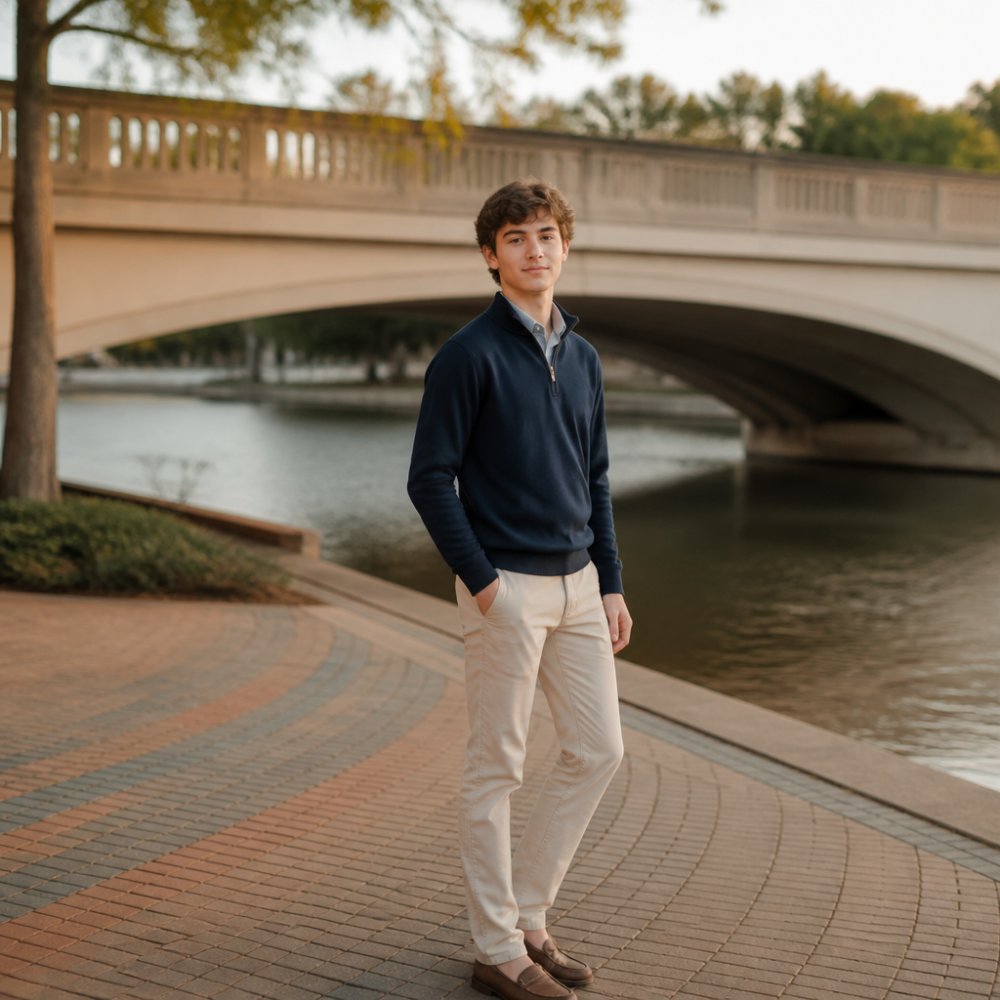
Place your hands intentionally. Slide one hand into a pocket. Let the other hang at your side or rest on your thigh. Avoid both hands in pockets, this can look defensive.
Hands in Your Pockets or on Your Hips
Hand placement can make or break a pose. Hands in pockets read casual and approachable. Slide them in naturally, not stuffed to the bottom, and let your thumbs rest outside the pocket opening. This creates cleaner lines than fully hidden hands.
Hands on your hips create confidence and presence. Keep your elbows bent at roughly 90 degrees. Don't clamp your arms against your ribs, this narrows your shoulders. Let your arms frame your body with some space between your arms and torso.
For either hand position, avoid stiffness. Your arms should feel like they belong there. The best poses feel like something you'd naturally do while standing and talking to a friend.
These standing poses work at virtually any location and offer different ways to position your hands and body.
| Pose | Hand Placement | Best For |
|---|---|---|
| Weight Shifted to One Leg | One hand in pocket, other at side or on thigh | Creating natural S-curve and dimension |
| Hands in Pockets | Thumbs resting outside pocket opening | Casual, approachable look |
| Hands on Hips | Elbows bent at roughly 90 degrees, space between arms and torso | Confidence and presence |
Senior Photo Poses with Movement
Movement is what separates a portrait that looks posed from one that looks alive. Walking, leaning, and reaching all give the body something to do, which relaxes the face. The trick is knowing how to move so the camera catches the right moment.
Walking and Natural Stride
Walk at your normal pace. Slower walks look staged and faster walks blur the frame. Let your arms swing in opposition to your legs, right arm forward when the left leg steps forward. Keep your shoulders loose and look toward the camera, slightly off-camera, or straight ahead.
Angle the walk slightly across the camera rather than straight toward or away from it. A diagonal path flatters proportions and gives your Master Photographer more usable frames. Walk through a location rather than stopping for each shot. Continuous movement produces the most natural expressions.
For a stronger frame, ask for a count. Your Master Photographer may say "walk on three" so you know when to step into the light. This removes the hesitation that shows up in the shoulders.
Leaning and Reaching
Lean against a wall, fence, or railing with one shoulder slightly lower than the other. Cross one leg in front of the other at the ankle. This creates shape and prevents the flat look of standing straight-on. Let one arm hang and rest the other on your leg or across your body. Turn your face toward the camera while the body angles away. That three-quarter view is flattering in almost any setting.
Reaching poses work best when based on real movement. Reach up to touch a branch at Mercer Botanic Gardens, reach down to adjust a shoe, or reach toward something just out of frame. The body follows the reach, producing a natural line through the arm and shoulder. Avoid lifting the shoulder toward the ear. Keep the neck long and the chin level.
Adapting Movement to Location and Light
Open space at Lake Conroe or Towne Lake suits walking frames because there is room to move without obstacles. Textured walls and railings at The Woodlands Waterway suit leaning frames. Greenery and flowers at Mercer Botanic Gardens suit reaching and interacting frames. Market Street offers clean architectural lines for walking frames with strong backgrounds.
Light changes the plan. In open sun, movement frames work best when you walk through shade or when the sun is behind you. In soft light, leaning frames hold detail in the face. Your Master Photographer will position you so the light falls where it flatters, and movement gives you room to find that spot naturally.
Framing the Movement
Full-body frames show the stride and the setting. Close-up frames crop out the legs and focus on the face and hands, which means the movement has to read in the shoulders and expression. Three-quarter frames split the difference and are the most versatile. Expect your session to include all three so you leave with variety.
Transitioning Between Movement Setups
Do not stop moving between setups. Walk to the next spot rather than standing and waiting. When you arrive, take one breath, reset your shoulders, and start the next movement. Small variations keep the energy up: change the direction of the walk, switch which hand is in your pocket, or turn the lean to the other shoulder.
How to Look Natural in Photos
Natural-looking poses come from preparation and intentional direction during your session.
Warm Up Before Your Session
Arrive ready to move. Do some light stretching before your session starts. Roll your shoulders backward and forward and tilt your head side to side. These movements loosen tension and help you feel comfortable in your body.
Walk around the location for a few minutes. Get familiar with the space. Notice where the light falls best. Notice textures and backgrounds you might use. This physical movement helps you settle in and reduces nervous energy.
Take some deep breaths. Breathe in through your nose for a count of four, hold for four, and exhale for four. This calms your nervous system. When you're physically relaxed, your expressions and poses look more authentic.
Use Prompts and Direction
Your Master Photographer will give you prompts and direction throughout your session. These aren't commands, they're suggestions that help you find natural poses and expressions. Common prompts include looking down briefly, then back up toward the camera. Or thinking about something that makes you smile rather than forcing a smile.
Movement prompts help too. "Walk toward me slowly." "Reach up and touch that branch." "Lean against the wall and look over your shoulder." These action-based prompts feel more natural than "stand here and pose."
When you receive direction, move into it without overthinking. The best poses come from responding naturally to prompts rather than trying to remember a checklist of positioning rules.
Senior Photo Pose Ideas with Different Body Types
Most pose guides assume one body and one comfort level, which leaves many high school seniors guessing. Treat every pose as a starting point and adjust it to the person in the frame. Below are the adjustments that matter most, organized by what you want the portrait to do.
Start With What You Want the Pose to Do
Before you worry about a specific stance, decide the goal. Do you want a longer line through the body? A broader, more grounded presence? A softer, more open expression? Each goal points to a different set of adjustments. When you know the goal, the pose becomes a tool instead of a rule.
Adjustments for a Longer, Leaner Line
Turn the body to a three-quarter angle rather than square to the camera. This is the single most reliable adjustment for slimming any frame. Shift weight onto the back leg and let the front knee bend slightly. Keep the shoulders level even as the hips angle. Raise the camera slightly above eye level and tilt the chin down a touch. The combination lengthens the neck and removes the flat, frontal look that widens most people.
Adjustments for a Broader, More Grounded Presence
Square the shoulders more toward the camera and stand tall through the spine. Let the arms rest slightly away from the torso so the shoulders read at full width. A lower camera angle adds presence. Hands on hips with elbows open, or hands resting on a prop at waist height, both widen the silhouette in a way that reads as confident rather than stiff.
Adjustments for Height
Standing poses protect your vertical line. If height matters to you, avoid deep sitting poses and perch instead. When you do sit, keep one foot flat and lean the torso forward slightly so the spine stays long. A camera angle at chest height or below keeps the full body in frame without compressing you.
Adjustments for Comfort and Mobility
Not every senior wants to kneel, climb, or hold a pose for long. Seated poses on a bench, low wall, or step at Old Town Spring give you stability without requiring balance. Leaning poses against a wall or railing at The Woodlands Waterway take the weight off your feet. If standing for long stretches is uncomfortable, tell your Master Photographer at the start. Poses can be sequenced with standing frames first, seated frames later, and breaks built in.
If you use a mobility aid, bring it and use it. A cane, a walking stick, or a wheelchair can be part of the portrait rather than hidden from it. The most authentic frames often come from working with what is actually yours.
Adjustments for Self-Consciousness
If you feel awkward in front of the camera, start with poses that give your hands a job. Hands in pockets, hands on a prop, or hands adjusting a jacket all remove the "what do I do with my arms" problem. Movement poses also help because the body is busy and the mind has less room to overthink.
The Rule That Overrides the Rest
A relaxed pose that fits your body always photographs better than a technically perfect pose that makes you tense. If a position feels wrong, say so. Your Master Photographer will adjust the angle, the camera height, or the pose itself until it fits you. The goal is a portrait that looks like who you really are, not a pose that looks like a template.
What to Wear for Senior Pictures
What you wear directly affects how poses look and feel. Clothing choices influence posture, hand placement, and overall confidence.
Outfit Choices That Photograph Well
Fitted clothing works better than loose or baggy pieces. Fitted doesn't mean tight, it means clothes that follow your natural lines without excess fabric bunching or hiding your shape.
Solid colors and simple patterns photograph better than busy prints. Solid colors create clean lines and keep focus on your face. Simple stripes or small checks work. Busy florals or large logos distract from you.
Avoid white or very light colors that can create glare or wash out your skin tone. Avoid black if you're photographing in very dark settings.
Layers add dimension and give you more posing options. A fitted jacket over a simple top, or a cardigan worn open, creates visual interest.
Discover outfit coordination strategies in our guide on what to wear for senior photos. Clothing and poses work together to create your best look.
Hand Placement and Props
Your hands need something to do in almost every pose. Clothing gives them options. Pockets let you slide hands in naturally. A jacket or cardigan gives you places to rest hands or create movement. A belt gives your hands a place to hook thumbs.
Props should feel personal and authentic. Holding something you genuinely use or love, a musical instrument, a sports ball, a book, a camera, creates natural hand placement and authentic expression. Props work best when they're part of your actual life, not generic studio props.
Avoid holding props in a stiff, formal way. Hold them as you naturally would. If you're holding a guitar, hold it like you're about to play. If you're holding a soccer ball, hold it like you're about to kick it. This creates poses that feel genuine rather than posed.
Pose Transitions and Variety During Your Session
Your session includes up to five hours and unlimited outfit changes. This time allows for multiple poses, locations, and variations. Pose transitions, moving smoothly from one pose to another, create more authentic moments and give your photographer more options.
Start with standing poses to warm up. These feel less vulnerable than sitting poses. Once you're settled, move into sitting and movement poses.
Between major pose changes, try small variations. Shift your weight slightly. Change where your hands rest. Tilt your head a different direction.
Use different locations throughout your session. Each offers different backgrounds, lighting, and posing opportunities. A textured wall works for leaning poses.
Change outfits when you want a fresh start or new energy. A new outfit often helps you feel re-energized and ready for different poses.
The goal is variety and authenticity, not perfection in every frame.
Learn how to prepare for your session and what to expect so you arrive ready to move through poses with confidence.
Schedule Your Free In-Home Consultation
Posing feels natural when you've had guidance beforehand. Your free 60-minute in-home consultation covers everything, from how to position your body to what to wear, from how to work with different locations to how to feel confident during your session. You'll understand exactly what to expect during your five-hour session.
Swartz Portraits photographs 100 high school seniors per year, no more than 8 from any single high school. This limit ensures each senior receives unhurried, personalized attention and a complete collection of museum-quality heirlooms handcrafted in Italy. Your proofs are revealed in person 7 to 10 days after your session, and you receive high-resolution files of every portrait for sharing and social media.
Learn how Swartz Portraits sessions work and what you'll receive.
Schedule your free in-home consultation.
Frequently Asked Questions
What should you do with your hands in senior photos?
Hand placement is one of the most important elements of posing for senior photos. Avoid leaving hands flat at your sides or clenched. Instead, place one or both hands in your pockets, rest them on a railing or textured surface, or position them naturally near your face or hair. When sitting, rest hands on your lap or let one drape over your knee. The key is to keep hands relaxed and purposeful, not stiff or awkward.
How do you pose naturally for senior photos?
Natural posing comes from movement and direction. Before your session, warm up with light stretching and a few practice poses to settle your nerves. During the shoot, follow your photographer's prompts to shift your weight, look down then up, laugh, or walk toward the camera. The more you move between poses, the more genuine expressions emerge. A Master Photographer will guide you through transitions that feel comfortable and authentic to who you are.
What are some flattering senior photo pose ideas?
Flattering senior photo pose ideas include sitting at an angle rather than straight-on, standing with weight on one leg to create shape, and incorporating movement like walking or leaning. For sitting poses, perch on the edge of a bench or rock rather than sinking back fully. Standing poses work best when you're angled toward the camera rather than facing it directly. Experiment with different outfit changes throughout your session to discover which poses complement your style and personality.
How can you add movement to senior portraits?
Movement creates energy and variety in senior portraits. Walk slowly toward or away from the camera, pause, and look back. Lean against a fence, railing, or tree and shift your weight. Reach up to touch tree branches or run your hand through your hair. These dynamic poses help you feel less stiff and give your photographer multiple angles and expressions to choose from. Movement also reveals your personality more authentically than static standing poses.