 how-to
What to Wear for Senior Photos: Complete Outfit Guide
Last Updated: October 23, 2026
Quick Summary
What to wear for senior photos should reflect your personality and make you feel confident. Choose between two to four outfits that combine well-fitted pieces in mid-tone, muted colors with subtle textures, avoiding busy patterns, logos, and trends that will date quickly.
- Bring two to four outfits: one dressy look, one casual look, and optionally one that reflects a personal interest.
- Build each outfit around one anchor piece, one neutral bottom, and one accent layer or accessory for intentional variety.
- Choose mid-tone, muted colors that flatter your skin in daylight and avoid pure white head-to-toe, all black, neon, and large logos.
- Test every outfit in daylight at least one week before your session, checking fit, color against your skin, and how patterns read from a distance.
- Plan your outfits three weeks ahead using three words that describe your desired look, then build from pieces you already own and wear regularly.
Table of Contents
- What to Wear for Senior Photos: Start With Your Personality
- Senior Photo Outfit Ideas for Girls
- Senior Photo Outfit Ideas for Guys
- What Colors to Wear for Senior Pictures
- How Many Outfits to Bring for Senior Pictures
- What Not to Wear for Senior Photos
- Outfit Planning Timeline and Checklist
- Final Thoughts on Senior Portrait Styling
- Frequently Asked Questions
What to Wear for Senior Photos: Start With Your Personality
The best outfit for senior photos is one that feels like you. Not what your parents think you should wear. Not what looks good on your best friend. What makes you feel confident when you see the portrait on the wall.
When you're planning what to wear for senior photos, you're deciding how you want to be remembered at this moment. The outfit shapes the entire portrait and sets the mood.
At Swartz Portraits, the portraits that stand out are the ones where personality comes through in every detail. That happens when the outfit matches who they actually are.
Start by asking yourself: What do I wear when I feel most like myself? Do you gravitate toward classic pieces or bold colors? Are you more comfortable in jeans? Do you like layering or textures like corduroy and crochet?
Your answers to these questions matter more than any trend.
Senior Photo Outfit Ideas for Girls
High school senior girls have more flexibility with what to wear for senior photos than most people realize. The key is choosing pieces that work together and make you feel confident.
Dressy Looks
A dressy outfit for senior photos doesn't mean formal or stiff. It means polished and intentional, the version of yourself you'd wear to something that matters.
A well-fitted blouse paired with dark jeans or tailored trousers works beautifully. Choose a classic white button-down, a light blue shirt, or a ruffled or textured piece. Layer with a blazer or sweater and add clean boots or shoes.
A dress or jumpsuit is another strong choice, and maxi skirts photograph well and give you room to move. Whatever you choose, make sure it fits well and doesn't distract from your face. Solid colors or subtle patterns work best.
Accessories matter in dressy looks. A simple necklace, earrings, or bracelet adds polish without overwhelming the portrait. Choose pieces you wear regularly, not something bought just for the session.
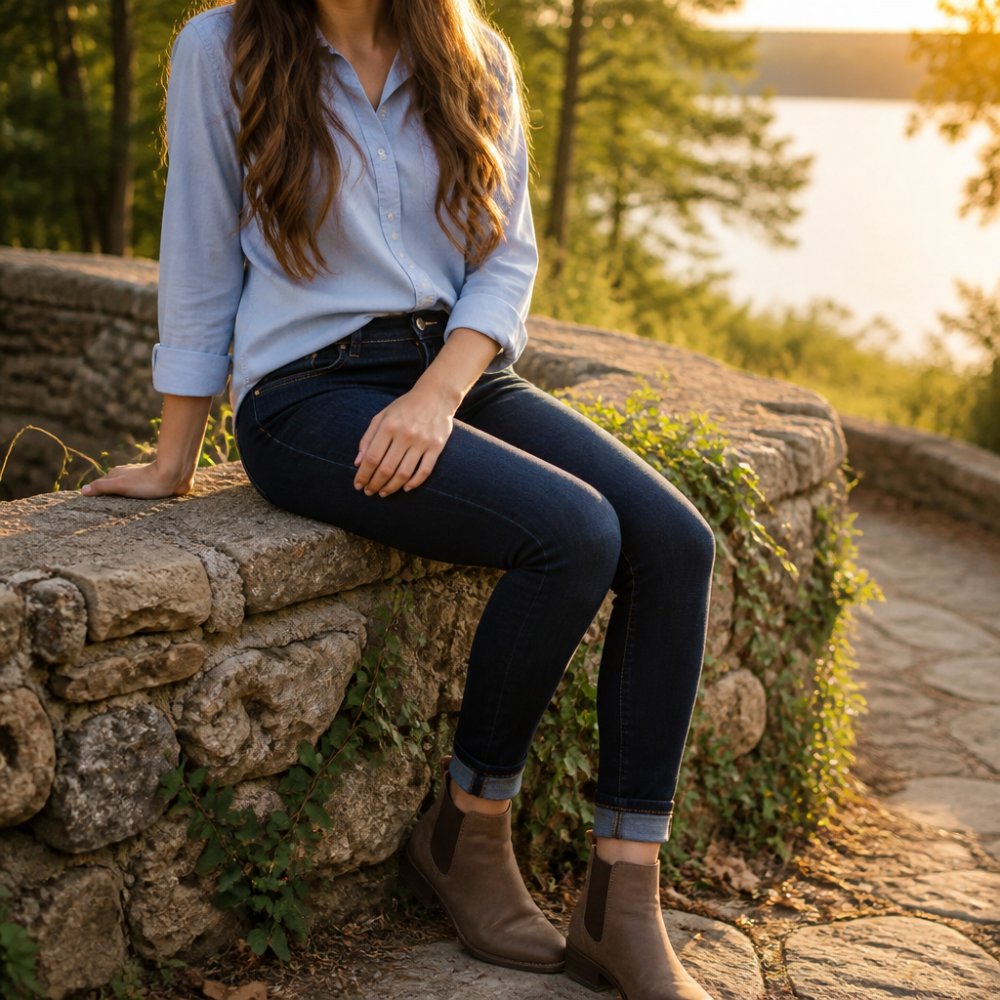
Casual Looks
Casual doesn't mean sloppy. It means comfortable and approachable. This is where many seniors feel most like themselves.
Dark jeans are the foundation of most casual outfits. Pair them with a simple sweater, a graphic tee, or a casual button-down. A denim jacket, cardigan, or flannel over a basic tee creates depth.
Textures photograph beautifully in casual looks. Corduroy, tweed, herringbone, crochet, or knit fabrics add dimension that solid colors alone can't achieve.
Khakis or chinos offer a middle ground between dressy and casual. They pair well with sweaters and button-ups and photograph as slightly more polished than jeans.
Comfortable shoes matter. Clean tennis shoes, boots, or casual loafers all work depending on the vibe you're going for. Make sure whatever you choose is clean and in good condition.
Senior Photo Outfit Ideas for Guys
What to wear for senior photos as a guy comes down to fit and simplicity. Well-fitted pieces in neutral tones create the strongest portraits.
Dressy Looks
A dressy look for guys typically starts with a button-down shirt in white, light blue, or a neutral tone. Make sure it fits well across the shoulders. Tuck it in or leave it untucked depending on what feels natural.
Layer with a sweater, cardigan, or blazer for more polish. A solid-colored sweater over a button-down creates a clean, intentional look, and a blazer elevates the outfit without feeling formal.
Dark jeans or neutral chinos complete the look. Make sure they fit well and aren't wrinkled. Clean, polished shoes tie everything together. Avoid anything too trendy or attention-grabbing.
Accessories for guys can be minimal. A watch, simple necklace, or hat can add personality without overwhelming the portrait. Keep it subtle.
Casual Looks
Casual outfits for guys start with well-fitted jeans or chinos. Dark colors photograph better than light ones. Make sure they fit through the thigh and taper at the ankle.
Layer a simple tee with a jacket, sweater, or flannel. A graphic tee under an open button-down works well, and textures like corduroy or tweed add visual interest.
Boots, clean sneakers, or casual shoes all work for casual portraits. Make sure they're in good condition. Worn-out or dirty shoes pull attention from your face.
Neutral colors and solid pieces create the strongest casual portraits. Avoid busy patterns or graphics that compete with your face for attention.
What Colors to Wear for Senior Pictures
Color is the fastest variable to change and the one most likely to decide whether a portrait feels like you. Once you understand how color behaves in front of a camera, you can judge any piece in your closet in about ten seconds.
How color actually photographs
A portrait is a study in contrast. Your face needs to sit as the brightest, most detailed part of the frame. Any color that outshines your skin or swallows your features wins the wrong fight.
Three things drive that balance.
Value is how light or dark a color reads. A bright white shirt in full sun can blow out and pull the eye off your face. A deep navy or forest green holds its shape and lets your skin stay the brightest note. Mid-tone colors are the safest default.
Saturation is how pure or intense a color is. A saturated red or electric blue reflects strongly and can cast a color fringe onto your chin and neck. Muted versions, like brick instead of fire-engine red, keep the color story without the cast.
Temperature is whether a color leans warm or cool. Warm tones like rust, camel, olive, and warm brown flatter most skin tones and sit comfortably against outdoor greens and golds. Cool tones like navy, slate, and deep teal read crisp and modern against stone, water, and urban backgrounds.
Patterns, prints, and logos
Small, tight prints read as texture from a few feet away and photograph as a soft, rich surface. Large, high-contrast prints read as shapes and compete with your face. Fine stripes, small florals, subtle plaids, and micro-dots are safe. Oversized graphics and bold geometric prints are not.
A useful test: hold the piece at arm's length and squint. If you see the pattern before the garment, it is too loud. If it reads as a single tone with depth, it will photograph well.
Logos deserve their own note. A large brand mark on the chest becomes the focal point of every frame it appears in. Keep logos small or skip them.
Building a palette that works together
You do not need one perfect color. You need two or three that agree with each other and with your skin.
A reliable formula is one anchor, one neutral, and one accent. The anchor is your dominant color, the neutral is your denim, chino, or trouser, and the accent is a layer, a shoe, or an accessory. This is why a rust sweater over cream with dark jeans reads as intentional while three unrelated brights read as noise.
Test your finalists in daylight, not under bathroom bulbs. Stand near a window and look at how each color treats the underside of your jaw and the area around your eyes. Colors that make shadows look gray or green are working against you. Colors that make your skin look even are working for you.
Colors to approach with care
Pure white head to toe is hard to expose without losing detail. Use white as a shirt, a layer, or a shoe rather than the whole outfit.
All black can flatten a portrait because it absorbs light and removes the shadows that give a face dimension. If black is genuinely your color, break it with a texture, a lighter layer, or a visible skin tone at the neck and hands.
Neon and highly saturated brights reflect onto skin and can tint your face. They also date quickly.
Very pale pastels can wash out fair skin in bright light. They can be lovely in soft shade or as an accent, but test them in daylight before you commit.
Match the color to the location
Outdoor locations bring their own palette. Green foliage and warm stone reward earth tones, olive, cream, camel, and rust. Water and sky reward navy, slate, and soft blue. Urban brick and concrete reward deep jewel tones and crisp neutrals.
If you are shooting at Lake Conroe, The Woodlands Waterway, or Mercer Botanic Gardens, warm earth tones and muted greens will sit naturally in the frame. At Market Street or Old Town Spring, you have more room for richer color against the architecture.
How Many Outfits to Bring for Senior Pictures
Most seniors bring between two and four outfits for their session. This gives you enough variety to show different sides of your personality without overwhelming yourself with choices.
Two outfits is the minimum. One dressy or polished look and one casual look gives you range. It shows different versions of yourself.
Three outfits is ideal for most sessions. This might be a dressy look, a casual jeans-and-sweater look, and something that represents a hobby or interest. Three outfits give you flexibility without creating decision fatigue during the session.
Four outfits works well if you want to explore different moods or styles. Maybe one dressy, two casual with different vibes, and one that's more personal or reflects an interest. Four is the upper limit before outfit changes start eating into your session time.
Unlimited outfit changes are included in your session at Swartz Portraits. This means you can bring as many options as you want and change throughout the session. The real question isn't how many you're allowed to bring. It's how many you can comfortably manage.
Here's what works in practice: choose your outfits ahead of time. Lay them out and photograph them on your phone. Pick the ones that make you feel most confident. Bring those. You can always bring a backup option if you're unsure about something, but avoid bringing too many choices. Decision fatigue is real, and it shows in portraits.
What Not to Wear for Senior Photos
Certain choices consistently distract from the portrait or date quickly. Avoid them.
Don't wear anything too trendy that will look dated in a year. Extreme styles, overly embellished pieces, or very trendy cuts can feel dated when you look back at your portraits in five years. Classic pieces with personality last longer.
Don't wear busy patterns or graphics that compete with your face. Large logos, busy prints, or graphics that take up most of your chest pull attention away from you. Subtle patterns or texture are fine. Busy is not.
Don't wear anything that doesn't fit well. Clothes that are too tight, too loose, or uncomfortable show in your face and posture. You can't relax and be yourself in clothes that don't feel good.
Don't wear wrinkled or stained clothing. Press your outfits before your session. Check for stains or damage. Your clothes should look fresh and intentional.
Don't wear anything you're not comfortable in. If you spend the whole session worrying about how something looks or feels, that discomfort shows. Stick with pieces you wear regularly and feel confident in.
Don't wear all black unless that's genuinely who you are. All black can look flat in portraits and can be harder to light well. If black is your color, pair it with another tone or texture to add dimension.
Don't wear white from head to toe unless you're going for a very specific look. It can be bright and overwhelming in portraits. White works best as part of an outfit, not the entire outfit.
Outfit Planning Timeline and Checklist
A portrait wardrobe comes together in stages, and the stages matter more than the calendar. Start about three weeks out so you have room to try, adjust, and swap without a last-minute scramble. Here is the sequence that works, plus the checklist that keeps it honest.
Three weeks out: define the story
Before you shop or dig through the closet, decide what the portraits should say. Write down three words that describe how you want to look. Classic. Relaxed. Bold. Soft. Grounded. Those three words become your filter for every piece you consider.
Then decide how many looks you want. Two to four is the practical range. One polished look, one relaxed look, and one that carries a personal interest covers most seniors well. At Swartz Portraits, outfit changes are unlimited across a session, so the limit is your energy and decision-making, not the clock.
Two weeks out: build from what you own
Start with your own closet. Most seniors already own the core of two strong outfits. Pull the pieces you wear when you feel most like yourself and lay them out together.
Build each look around one anchor piece, then add a neutral and an accent. This is the same formula that governs color, applied to the whole outfit. A favorite sweater, a dress you love, a jacket that fits perfectly. Then denim or chinos. Then a layer, a shoe, or an accessory.
This is also where budget discipline happens. Reusing what you own is not a compromise. It is usually the reason a portrait looks like the person in it. If you buy, buy one piece that elevates an outfit you already have rather than a whole new look you will wear once.
One week out: test in the mirror and on camera
Try each outfit on fully, shoes included. Then do three things.
First, sit, stand, walk, and raise your arms. Anything that pulls, gaps, or rides up will show in a portrait where you are moving and posing for hours.
Second, photograph yourself in each look in daylight. Your phone camera is a useful preview of how fabric, color, and fit read in a frame. Look for wrinkles, visible logos, and colors that fight your skin.
Third, check the details. Hem length, sleeve length, and how a layer sits at the shoulder all matter more in a portrait than in daily life.
Three days out: finalize and prep
Choose your final looks and stop shopping. Decision fatigue is real, and it shows in the face. Press everything, check shoes for scuffs, and gather accessories in one place. Pack each look together so nothing gets separated.
Day of the session
Arrive in something comfortable to travel in. Bring your looks on hangers or folded flat in a garment bag. Bring a small bag with touch-up items if you wear makeup, plus water and a snack. Give yourself time to settle in before the first frame.
The planning checklist
| Stage | Question to answer | Done |
|---|---|---|
| Story | Do I have three words that describe the look I want? | |
| Count | Have I chosen two to four looks? | |
| Anchor | Does each look have one clear anchor piece? | |
| Fit | Can I sit, stand, and move comfortably in every piece? | |
| Color | Does each color make my skin look even in daylight? | |
| Pattern | Do the prints read as texture, not as shapes? | |
| Logos | Are brand marks small or absent? | |
| Shoes | Are they clean, comfortable, and in good condition? | |
| Layers | Does each look have depth through a layer or texture? | |
| Personality | Does each look feel like me on a good day? | |
| Variety | Do the looks show different sides of me? | |
| Prep | Is everything clean, pressed, and packed together? |
Final Thoughts on Senior Portrait Styling
Your senior photos are a milestone. They mark a moment in time when you're becoming who you're meant to be. The outfit you choose is part of that story.
The strongest senior portraits happen when the student feels like themselves. When they're not worried about how they look or whether they made the right choice. When they can relax and be present.
This is why starting with your personality matters. When you choose outfits that reflect who you actually are, everything else follows. You feel confident. You relax. The portrait captures something real.
Bring outfits that make you feel good. Pieces you'd actually wear. Colors that make you feel alive. Textures and styles that feel authentic to you. Leave room for your personality to shine through.
Your senior portraits are for you. They're for your family. They're a record of who you are right now. Make choices that honor that.
Frequently Asked Questions
How many outfits should I bring to a senior photo session?
Most seniors bring 3 to 5 outfits to maximize variety across the session. Since you have an unhurried senior portrait session with unlimited outfit changes, multiple looks let you show different facets of your personality. Plan at least one dressy outfit, one casual look, and one that reflects your personal style or interests. Having backup options ensures you'll have a strong range to choose from when reviewing your proofs.
What colors photograph best for senior pictures?
Warm colors like jewel tones, earth tones, and rich jewel tones photograph beautifully in senior portraits. Solid colors or subtle textures work better than busy patterns. Consider how colors complement your skin tone and hair color. Neutrals like cream, tan, and soft gray are timeless, while deeper shades like navy, burgundy, and forest green add depth. Avoid neon or overly bright colors that can overwhelm the image or distract from your face.
What should I avoid wearing for senior photos?
Skip busy patterns, logos, and text-heavy graphics that distract from your face. Avoid overly trendy pieces that may look dated in a few years, since these portraits are meant to be heirlooms. Steer clear of wrinkled or ill-fitting clothing, and don't wear anything that makes you uncomfortable or self-conscious. Busy backgrounds in your outfit compete with outdoor settings like Lake Conroe or The Woodlands Waterway. Keep accessories minimal and intentional so they enhance rather than overwhelm your look.
Should I wear casual and dressy outfits for my senior portrait session?
Yes. A mix of casual and dressy looks gives you versatility and lets your personality shine through multiple ways. Casual outfits feel relaxed and authentic, while dressy pieces create more polished, timeless portraits. With unlimited outfit changes during your session, you can shift between both styles and capture who you are in different contexts. This variety also gives your family options when selecting final portraits for wall art and heirlooms.
Your senior year is a moment you won't get back. The right portrait captures that moment authentically. Schedule your free in-home consultation to discuss your vision, explore location options, and plan the outfits that will make your portraits feel like you. We work with 100 high school seniors per year, and we take no more than 8 from any single school. This means your session gets the time and attention it deserves.