 how-to
Senior Portrait Session Length Guide
Table of Contents
- How Long Is a Senior Portrait Session
- What Affects Your Senior Portrait Session Length
- Senior Picture Outfit Ideas and Planning
- Senior Portrait Session Timeline: A Minute-by-Minute Breakdown
- Choosing Senior Portrait Locations
- What to Bring to a Senior Portrait Session
- Planning Your Session Schedule
- Frequently Asked Questions
Last Updated: October 11, 2026
How Long Is a Senior Portrait Session
At Swartz Portraits, sessions can last up to five hours, allowing for multiple outfits and locations. The session length is tailored to your vision, ensuring an unhurried experience that captures genuine moments.
At Swartz Portraits, we structure each session around your vision. Some seniors come with one outfit and one location in mind. Others want to explore multiple looks across different backdrops. The session length guides how much ground you can cover. Understanding what affects your senior portrait session length helps you plan accordingly and get the most from your time with the Master Photographer.
The real advantage of knowing your session duration upfront is that you can prepare mentally and practically. You'll know how many outfit changes make sense. You'll understand why certain times of day matter for natural light. You'll arrive ready to move through the session with intention rather than rushing or feeling like you've overstayed your welcome.
What Affects Your Senior Portrait Session Length
Three main factors shape how long your senior portrait session will be: the number of outfits you wear, how many locations you visit, and what time of day you schedule the session. Understanding how these variables interact helps you choose a realistic duration instead of guessing.
Outfit Count and Styling Time
Each outfit change takes time beyond just slipping on new clothes. The first outfit is usually ready before you arrive or put on as you're settling in. Subsequent changes require finding a private space (car, restroom, or designated area), changing clothes, refreshing hair and makeup if needed, and walking back to the shooting location. Budget roughly 10 to 15 minutes per outfit change once you're beyond the first look.
The number of outfits you choose influences the session length, allowing for a relaxed pace rather than a rushed one. The styling time is part of the session experience, giving you a moment to breathe, adjust your mindset, and transition into a different version of yourself.
Think about what matters to you. Do you want to show your everyday style, your formal side, and one wild-card look? Or is one carefully chosen outfit enough? Your answer determines how much session time you actually need.
Number of Locations
Moving between locations adds time in ways that aren't always obvious. Travel time between spots, walking to find the best angles at each location, resetting your comfort level at a new backdrop, and equipment setup all add up. A single location keeps your session focused and maximizes shooting time. You arrive, settle in, and work through different poses and angles without travel friction.
Two locations typically add 30 to 45 minutes to your session when accounting for driving, parking, walking to the best vantage points, and the mental reset that comes with a new environment. Three locations can add an hour or more, depending on distances and how much you want to explore each place.
The time required for outfit changes and travel between locations means that actual shooting time is less than the total session duration. Planning for these transitions helps ensure a relaxed experience.
The trade-off is worth considering. One stunning location with multiple outfit changes can yield as much variety as three locations with one outfit. Conversely, returning to a beloved spot with a different outfit often produces your favorite portraits because you're relaxed and familiar with the space.
Time of Day and Natural Light
Golden hour, the hour before sunset, delivers the most flattering natural light for senior portraits. The sun sits lower, creating warm tones and soft shadows that sculpt your features beautifully. Sunrise offers similar quality but requires an earlier start.
Shooting during golden hour means your session is time-sensitive. You have roughly 45 minutes to an hour of optimal light before it fades. A session scheduled for mid-afternoon has more flexibility. The light is harsher and less forgiving, but you have a wider window to work within. You're not racing against the clock.
Many families choose to end their session as golden hour approaches, capturing the final 30 to 45 minutes in that premium light. Others schedule their entire session during golden hour and accept that the shooting window is narrower but the results are exceptional. Some prefer the freedom of an earlier time slot and accept that the light won't be as dramatic.
Putting It Together: A Simple Duration Calculator
Use this framework to estimate your realistic session length:
Start with your base: one hour for one outfit at one location with flexible timing.
Add 10 to 15 minutes for each additional outfit beyond the first.
Add 30 to 45 minutes for each additional location.
If you're shooting during golden hour, add 15 to 30 minutes to your total to account for the time-sensitive nature of that light and the mental focus it requires.
Example: You want two outfits, two locations, and you're aiming for golden hour. Base (60 minutes) plus one outfit change (15 minutes) plus one location transition (40 minutes) plus golden hour buffer (20 minutes) equals roughly 135 minutes, or just over two hours. A two-and-a-half-hour session would give you breathing room.
Another example: You want three outfits, one location, flexible timing. Base (60 minutes) plus two outfit changes (30 minutes) equals 90 minutes, or 1.5 hours. A two-hour session is plenty.
Senior Picture Outfit Ideas and Planning
Your outfit choices shape how your portraits tell your story. Think about what you want to communicate: your everyday personality, your aspirations, your sense of humor, or a formal version of yourself.
A classic approach includes one casual outfit (jeans and a favorite top), one polished look (dress or dressy separates), and one outfit that feels uniquely you (whether that's athletic wear, vintage pieces, or something with cultural significance). This combination gives you range without overwhelming your session.
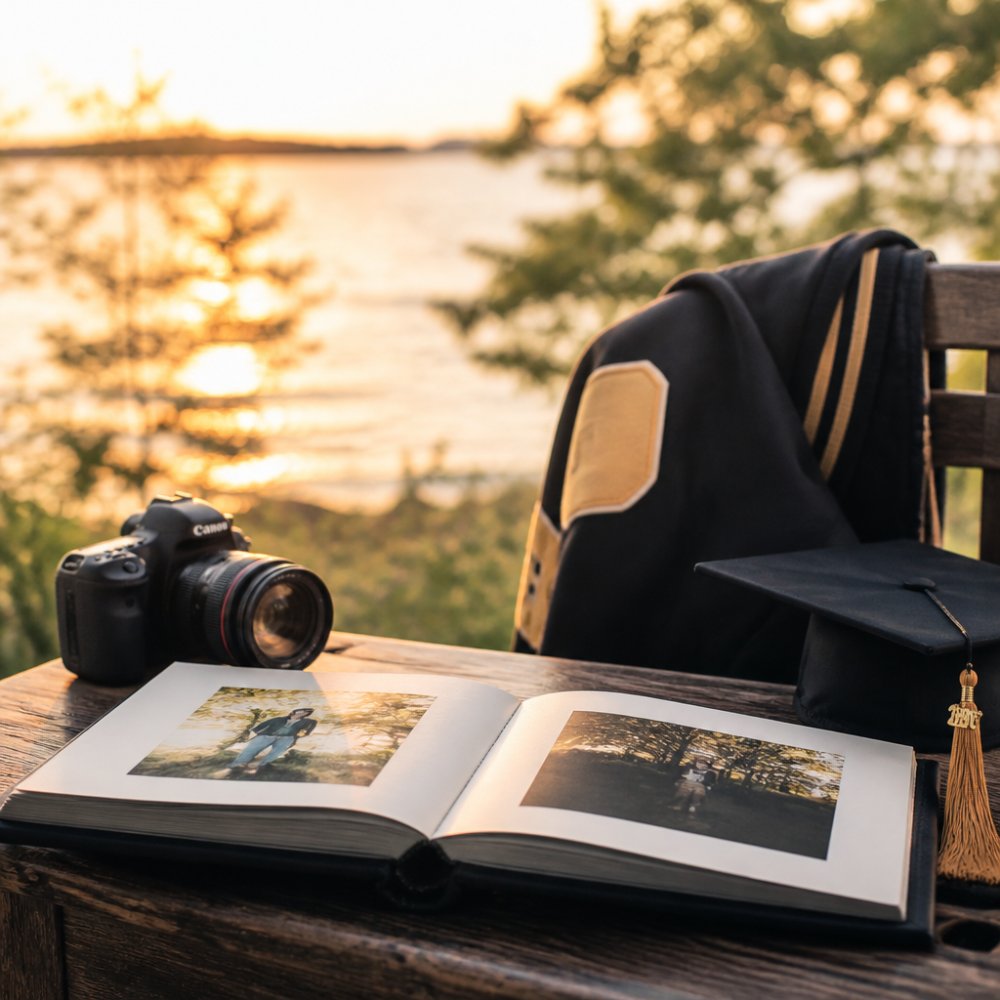
Solid colors and simple patterns photograph better than busy prints. Jewel tones, neutrals, and pastels tend to look timeless in portraits. Avoid logos and text unless they're meaningful to your identity. Layers add visual interest and give you options, you can remove a jacket or cardigan to change the look without a full outfit change.
Comfort matters more than trends. If you're tugging at your clothes or feeling self-conscious, that tension reads in your portraits. Wear what makes you feel like yourself.
Plan outfits that feel authentic to who you are right now, not who you think you should be. Your best portraits happen when you're genuinely comfortable.
Senior Portrait Session Timeline: A Minute-by-Minute Breakdown
Understanding how a session actually unfolds helps you prepare mentally and manage your energy. Here are three realistic timelines based on different session structures.
Two-Hour Session: One Location, Two Outfits
0-10 minutes: Arrival and settling in. You arrive, find a comfortable spot, and get oriented. The Master Photographer discusses the plan, answers last-minute questions, and helps you relax. This transition from everyday mode to portrait mode matters.
10-50 minutes: First outfit, first location. You're in your first look at your chosen location. The photographer works through different poses, angles, and expressions. You're finding your rhythm, learning how to move in front of the camera, and building confidence. The light is being used strategically.
50-65 minutes: Outfit change. You step away to change clothes, refresh hair and makeup if needed, and return ready for the next set. This is a natural pause in the session.
65-110 minutes: Second outfit, same location. You're warmed up now. You know how to move, where to look, and what feels natural. Your second outfit often produces some of your best shots because you're relaxed and the photographer has learned your angles. You're exploring different poses within the same familiar backdrop.
110-120 minutes: Wrap-up and next steps. The photographer reviews a few images with you, discusses the next phase (proofs, ordering, timelines), and thanks you for your time. You leave knowing what to expect.
Three-Hour Session: Two Locations, Two Outfits
0-10 minutes: Arrival and settling in at location one. You arrive, orient yourself, and transition into portrait mode.
10-55 minutes: First outfit, first location. Shooting in your first look at the first location. You're building confidence and the photographer is learning your best angles.
55-70 minutes: Travel and transition to location two. This includes driving, parking, walking to the best vantage points, and resetting your comfort level in a new environment. This is real time that affects your session.
70-100 minutes: First outfit, second location. You're in the same outfit but a different backdrop. The change of scenery often brings fresh energy and different visual possibilities.
100-115 minutes: Outfit change at location two. You change clothes and refresh as needed.
115-165 minutes: Second outfit, second location. You're in your second outfit at the second location. By this point, you've built real rapport with the photographer. The portraits often feel less posed and more genuinely you.
165-180 minutes: Wrap-up and next steps. Final review, discussion of next phases, and departure.
Four-Hour Session: Two Locations, Three Outfits
0-10 minutes: Arrival and settling in at location one. Transition and orientation.
10-50 minutes: First outfit, first location. Building confidence and establishing your rhythm.
50-65 minutes: Outfit change at location one. You change into your second outfit.
65-105 minutes: Second outfit, first location. Exploring your second look at the familiar first location.
105-120 minutes: Travel and transition to location two. Driving, parking, walking, and resetting.
120-145 minutes: Second outfit, second location. Continuing in your second outfit at the new backdrop.
145-160 minutes: Outfit change at location two. You change into your third outfit.
160-220 minutes: Third outfit, second location. You're in your third look at the second location. Energy and comfort are high. The photographer has a clear sense of your best angles and expressions. These final portraits often feel the most natural.
220-240 minutes: Wrap-up and next steps. Final review, discussion of proofs and ordering, and departure.
What These Timelines Show
Notice that actual shooting time is less than total session time. Travel, outfit changes, and transitions are real. Actual shooting time is less than total session time, as travel, outfit changes, and transitions are part of the experience.
Notice also that by the final outfit or location, you're relaxed and the photographer understands your angles. Some of your best portraits often come in the final hour because the initial awkwardness has dissolved.
Adjusting for Your Priorities
If you want maximum variety in one session, prioritize multiple outfits over multiple locations. If you want to go deep into a location you love, choose one or two locations and use your session time for outfit changes and exploration within those spaces. If you're shooting during golden hour, add buffer time because that light window is narrow and the photographer will be working with intention during those final minutes.
The Master Photographer will help you structure your session timeline during your free in-home consultation based on your specific goals, outfit count, location choices, and time-of-day preference.
Choosing Senior Portrait Locations
The location sets the mood for your entire session. It's the backdrop, yes, but it's also the environment that shapes your comfort and the story your portraits tell.
Public parks and gardens offer variety and beauty. Lake Conroe, The Woodlands Waterway, Mercer Botanic Gardens, and Towne Lake all provide natural settings with different character. Old Town Spring brings historic charm and architectural interest. Market Street offers urban sophistication. These locations are accessible, photographically interesting, and meaningful to many families.
A single location keeps your session focused. You arrive, you explore different angles and poses within that space, and you go deep rather than wide. This approach often produces a cohesive set of portraits that tell a unified story.
Multiple locations give you contrast. Moving from a natural setting to an urban backdrop, or from open sky to tree cover, changes the mood and aesthetic of your portraits. The trade-off is session time and energy.
Consider what matters to you. Is there a place that holds significance? A park where you've spent time, a neighborhood where you grew up, a botanical garden that reflects your aesthetic? Choosing a location with meaning often translates into more authentic portraits because you're comfortable and emotionally connected to the space.
What to Bring to a Senior Portrait Session
Bring more than you think you need. Extra socks, a change of shoes, bobby pins, and a small mirror are practical. A phone charger keeps devices ready. A light jacket or sweater helps if the temperature drops or if you need a quick layer change.
Bring your outfits on hangers if possible, rather than folded. This keeps them fresh and wrinkle-free. If you're changing in a car or a public restroom, having them ready to slip on matters.
Bring water and a light snack. Sessions are active. You're moving, posing, and concentrating. Staying hydrated and keeping your energy up prevents fatigue from showing in later portraits.
Bring a sense of openness. The best portraits happen when you're willing to try poses that feel slightly awkward at first. Trust the Master Photographer's direction. Most poses that feel strange in the moment look natural and beautiful in the final image.
Planning Your Session Schedule
Start by deciding what you want from your portraits. Are you creating images for yearbook submission, social media, wall art, or all three? Your answer influences how many outfits and locations make sense.
Check yearbook deadlines early. Many schools have submission windows that close weeks before graduation. Knowing your deadline ensures you schedule your session with enough time for proofs to be revealed and any final decisions to be made.
Consider the time of year. Seasons affect lighting, foliage, and your own availability. Spring and fall offer mild temperatures and beautiful natural backdrops. Summer light is intense and requires careful timing. Winter brings shorter days and limited golden hour windows.
Think about your own schedule. Are you balancing school, sports, work, or other commitments? A session length that fits your life prevents stress. A two-hour session might work if you're busy. A four-hour session suits someone with more flexibility.
Communicate your vision clearly during your free in-home consultation. Discuss outfit ideas, location preferences, and how many images you hope to receive. The Master Photographer will help you understand what's realistic within your chosen session length and offer guidance based on 40 years of experience photographing high school seniors.
Frequently Asked Questions
How long does a typical senior portrait session last?
A typical senior portrait session lasts between 2 to 5 hours, depending on the number of outfits, locations, and time of day. Most sessions include multiple outfit changes and location moves, with time built in for posing, camera comfort, and natural transitions. The exact length is determined during your free in-home consultation, where you'll discuss your senior's vision and preferences.
How does outfit count affect senior portrait session length?
Each outfit change requires time for the senior to change, adjust styling, reset lighting and camera positioning, and capture variety with the new look. A session with more outfits requires more time. Unlimited outfit changes are included in your session, so you can plan for as many as your timeline allows.
What should I bring to a senior portrait session?
Bring all planned outfits, shoes, and accessories in their final form. Bring water and light snacks for energy during the session. If shooting near sunset, bring a light jacket for warmth. Have your senior's phone ready for any last-minute references or inspiration photos. Bring any props that reflect your senior's personality or interests. Comfortable transportation and a willingness to move between locations are also essential.
Can you fit multiple locations into one senior portrait session?
Yes. Multiple locations are included in your session, and the number depends on proximity and session length. Two nearby locations within 10 to 15 minutes of each other work well in a standard session. Three or more locations are possible in an extended 4 to 5 hour session, but travel time, setup, and transitions all factor into how many you can realistically cover. Your free in-home consultation will help determine the best location strategy for your timeline.
A senior portrait session is not a quick transaction. It's an experience designed around you. The time you invest, whether that's two hours or five, shapes the portraits you'll treasure for decades. Understanding what affects your senior portrait session length helps you make choices that align with your vision and your life.
Schedule your free in-home consultation.